
A man from Karaikal recently described his palms this way: “always cracked, like dried-up mud after summer.” He used antifungal cream for months. He thought the humidity was causing the cracking. But it wasn’t a fungal infection. It was psoriasis on his palms and soles. People often mistake this form of psoriasis for something else, because of where it shows up.
Do you have thick, scaly patches on your palms or soles? Are they sometimes painful? Here’s what’s actually going on — and what a traditional Siddha approach to managing it looks like in practice.
What Is Psoriasis on the Palms and Soles?
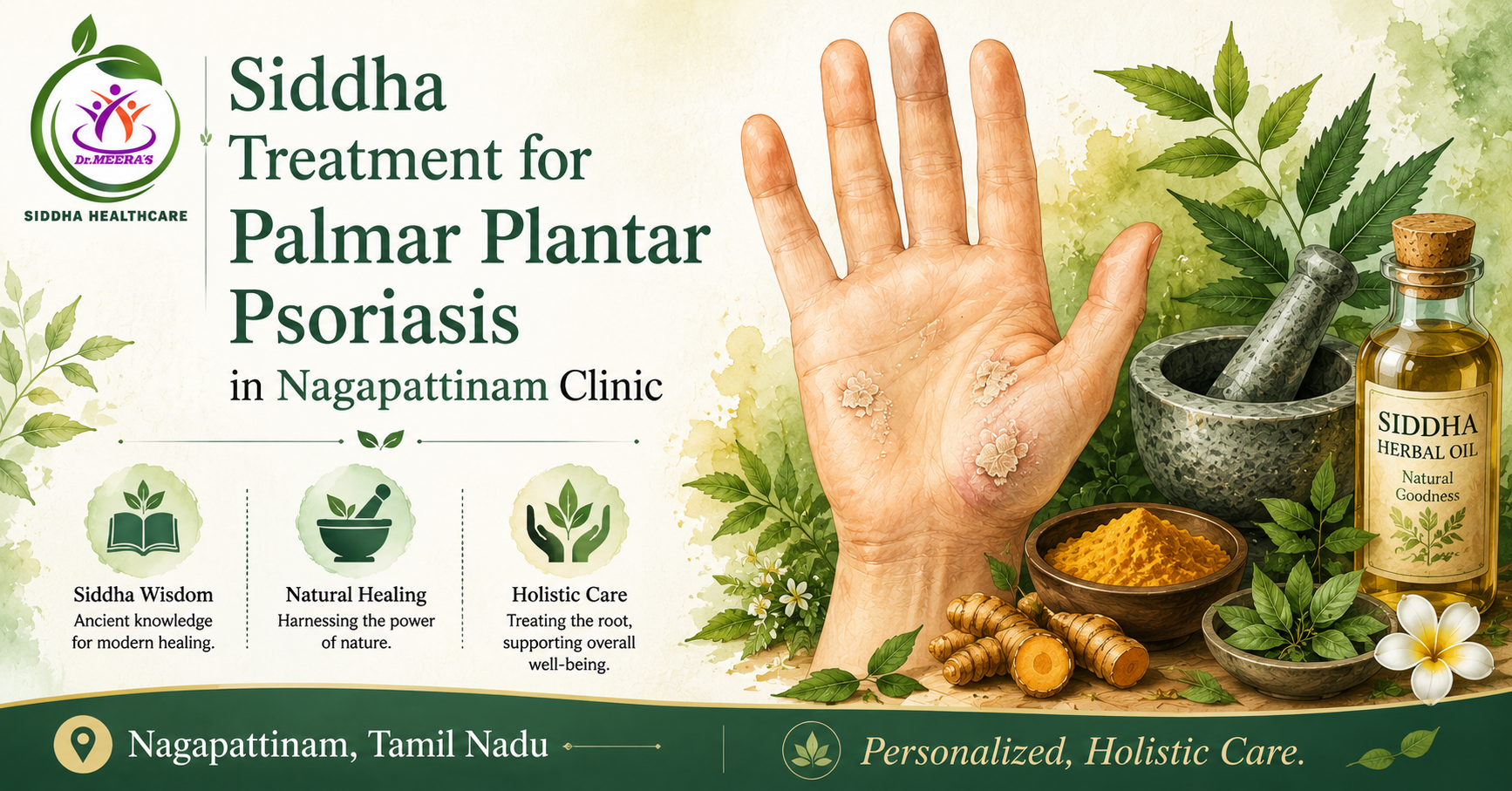
Psoriasis is a chronic skin condition linked to the immune system. The immune system makes new skin cells much faster than normal. On the palms and soles, the skin is naturally thicker. So psoriasis here often shows up as thick, well-defined patches with a yellowish-white scale. Sometimes it causes deep, painful cracks. This is a long-term condition. It moves through cycles — flare-ups, then calmer periods.
 Why Hands and Feet Are Different
Your palms and soles have the thickest skin on your body. This skin handles grip and pressure every day. But that thickness also makes psoriasis harder to manage here than on the elbows or scalp. Topical treatments penetrate more slowly through thick skin. And daily activities — handling fishing nets, gripping tools, walking, standing for long hours — keep putting stress on the skin. This stress can slow down healing. So psoriasis on the hands and feet often interferes with daily work more than psoriasis elsewhere on the body.
What Triggers a Flare-Up in This Region
A few common triggers show up again and again. These include prolonged sweating in humid weather, friction from manual work, stress, minor cuts, and sometimes an infection beforehand. Coastal humidity around Nagapattinam and Karaikal can cut both ways. For some people, it helps. For others, it’s a trigger — especially when skin stays damp for long stretches inside boots, gloves, or wet clothing.
This is also where the fungal-infection mix-up usually happens. During humid months, many people assume persistent scaling on the hands or feet is a fungal infection. That makes sense, because fungal infections are far more common in this climate. But there’s a practical difference. A fungal infection on the skin usually responds to antifungal cream within a couple of weeks. If thick, scaly patches don’t improve despite antifungal treatment, that’s a strong signal. It’s worth getting properly examined instead of continuing to self-treat.
What Siddha Medicine Calls This Condition
Siddha medicine calls this condition Kalaanjaga Padai (காளாஞ்சக படை). The classical Siddha text Yugi Vaithiya Chinthamani describes it. Sage Yugi wrote this text, and it discusses Kalaanjaga Padai alongside joint-related concerns. So Siddha tradition treats Kalaanjaga Padai as the same condition modern medicine calls psoriasis.
A Siddha Approach to Managing Palmar Plantar Psoriasis
A traditional Siddha assessment looks at your overall constitution, not just the skin patch. This assessment shapes the care plan. The plan can include external applications, internal formulations, and pathiyam (structured dietary and lifestyle guidance). So each plan fits the person — it’s not a fixed protocol.
This isn’t just folklore. It’s an active area of research today. Research institutions are studying herbo-mineral Siddha formulations specifically for psoriasis. The Ministry of AYUSH also notes that Siddha medicine has a long history of managing chronic skin conditions, including psoriasis. A 2025 case report adds more to this picture: researchers documented a patient who used traditional Siddha therapies alongside dermatology supervision. But the researchers were clear about one thing. Guideline-directed dermatology treatment should stay at the center of psoriasis care. So think of Siddha medicine as a complementary, supportive approach — not a replacement for it.
(Internal link: “explore the treatments offered at our clinic“)
What to Realistically Expect
A traditional Siddha approach to managing palmar plantar psoriasis focuses on two things. It aims to reduce how often and how severely flares happen. And it supports skin health over time. This isn’t a one-time fix. Psoriasis is a long-term condition, so results and timelines vary from person to person. Ongoing care — not a single visit — usually makes the difference.
When to See a Doctor
See a doctor instead of self-treating if you notice any of these:
- The scaling or cracking doesn’t improve with over-the-counter creams after two weeks.
- Pain interferes with your grip, walking, or work.
- You notice changes in your nails.
- You have joint pain along with the skin symptoms.
Consult Dr. Sathyameera before starting any treatment based on this article.
(Internal link: “book a consultation” — links to homepage/contact)
You can reach the clinic at 86676 30884 by call or WhatsApp. Consulting hours are Mon–Sat, 5:00 PM–8:30 PM, with the Medicine Counter open 10:00 AM–8:30 PM. On Sundays, consulting is 12:00 PM–2:00 PM by appointment, and the Medicine Counter is open 10:00 AM–2:00 PM.
Frequently Asked Questions
Is this the same as a fungal infection on my hands and feet?
No. They can look similar, especially in humid weather. But a fungal infection usually responds to antifungal cream within a couple of weeks. If the scaling persists despite that, it’s worth getting examined for psoriasis.
Is psoriasis contagious?
No. You cannot catch psoriasis from another person.
Will it go away completely?
Psoriasis is a long-term condition. It tends to come and go in cycles. With consistent care, many people reduce how often and how severely it flares. But “permanently cured” isn’t an accurate way to describe this condition.
Does the humid climate in Nagapattinam or Karaikal make it worse?
For some people, yes. Prolonged sweating and dampness are common triggers. Others find their skin behaves differently. Triggers vary from person to person, which is part of why an individualised assessment matters.
What does Siddha medicine call this condition?
Kalaanjaga Padai (காளாஞ்சக படை).
Can Siddha treatment help manage palmar plantar psoriasis?
A traditional Siddha approach may help manage symptoms for some patients, often alongside dermatology care. Consult Dr. Sathyameera before starting any treatment based on this article.
- Ministry of AYUSH — Siddha Diagnosis & Treatment: https://main.ayush.gov.in/about-the-systems/siddha/diagnosis-and-treatment
- AYUSH Next — Siddha research on Kalanjagapadai/psoriasis: https://ayushnext.ayush.gov.in/detail/story/rediscovering-siddha-treatment-for-psoriasis-kalanjagapadai-with-gandhaga-mezhugu-a-siddha-herbo-mineral-formulation
- PMC case report (2025), Siddha therapy + dermatology supervision: https://pmc.ncbi.nlm.nih.gov/articles/PMC12335859/
Pingback: சொரியாசிஸ்: கை, பாத சித்த மருத்துவ சிகிச்சை — காரைக்கால்